
REVIEW · JAPAN
Easy for everyone! Now you can play handmade mini shamisen and show off to everyone! Musical instruments, sweets and live music
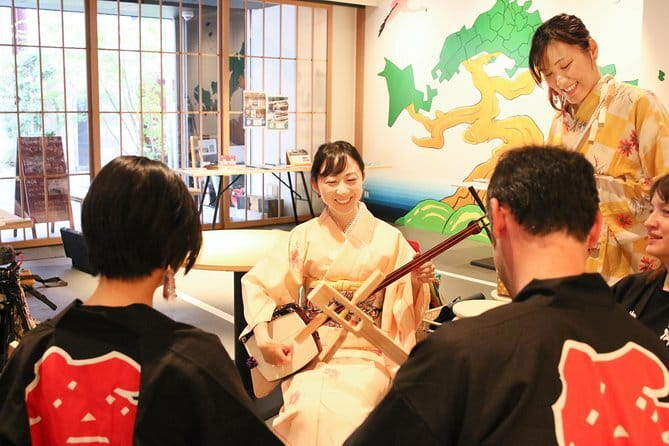
Make music you can take home. This two-hour workshop near Tokorozawa gives you a rare chance to build a handmade mini shamisen, learn a few simple songs, and hear live traditional music in a Japanese-style room. I especially like that the instrument is included and that the teacher welcomes complete beginners.
I also like the small group size, limited to four people, and the relaxed mix of craft, music, tea, and conversation. The main drawback is the price: at $182.09 per person, this costs far more than a simple museum visit or short cultural demonstration. You are paying for a take-home instrument, personal instruction, and a full hands-on session.
The workshop begins at Tokorozawa Station at 1:00 p.m. Pickup is offered, and the meeting point is near public transportation. The session is suitable for elementary school students and older, so it can work for families, couples, and solo visitors who want something more personal than a quick photo stop.
Key things to know before booking
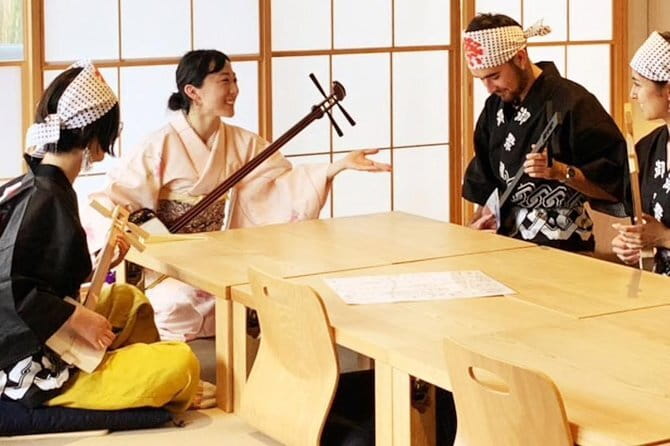
- Build your own mini shamisen: The introductory kit can be assembled in about 20 minutes, with guidance from the teacher.
- Play before you leave: You learn how to hold the instrument, read simple numbered music, and play a few songs as a group.
- Take the instrument home: The handmade mini shamisen, along with the music you practiced, is yours to keep.
- Hear live shamisen music: The workshop includes a performance with tea and sweets during the break.
- Small groups matter: With a maximum of four people, the teacher can give beginners close attention.
- A gentle first step: The session explains the instrument’s features and background without assuming any musical training.
What makes this shamisen workshop special
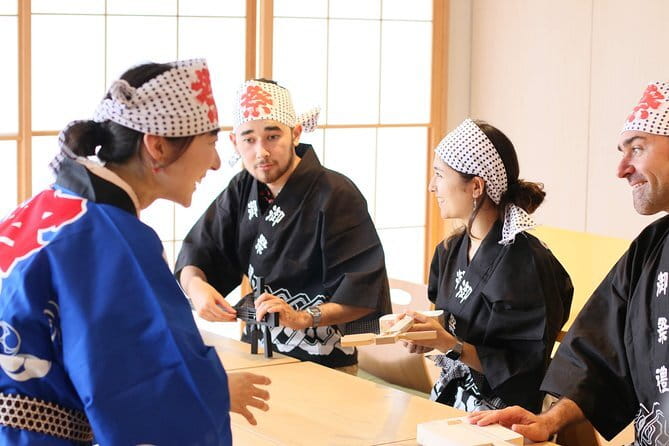
The shamisen is one of Japan’s best-known traditional instruments, but it can feel out of reach. Full-size instruments, unfamiliar playing techniques, and formal lessons may intimidate first-timers. TOKYO SHAMI EXPERIENCE lowers that barrier with a smaller instrument, simple music, and a teacher-led format.
I like the way the workshop combines several activities instead of asking you to sit through a long lecture. You make something with your hands, hear an explanation, practice a song, perform with the group, and then listen to a live demonstration. Each part helps the next one make sense.
The setting also adds something important. The session takes place in a relaxing Japanese-style room at a tea teacher’s house. That gives the workshop a more personal feel than a large commercial attraction. Depending on the timing, you may also have a chance to meet people from other countries, since the activity welcomes international participants.
There is a practical benefit, too. You do not simply leave with a memory and a few photographs. You take home the mini shamisen you made, plus the sheet music used during the session. If you want to keep practicing after your visit, you have the basic tools to do so.
More Dessert Tours around Japan:
- Strauss Exhibition incl. LED Concert Show / Coffee + Strauss Cake
★ 5.0 · 30 reviews - Paris Walk: Opera to Montmartre with Pastry & Chocolate
★ 5.0 · 4 reviews
Starting at Tokorozawa Station at 1:00 p.m.
The meeting point is Tokorozawa Station in Saitama Prefecture, with a scheduled start at 1:00 p.m. The location is near public transportation, which is useful because you can reach the activity without needing a car.
Pickup is offered, but you should confirm the exact arrangement when booking. The available information identifies Tokorozawa Station as the start point, so do not assume that pickup means door-to-door collection from your hotel.
The afternoon timing works well if you are staying in the area or building a day around western Saitama. It also gives you a clear two-hour block rather than an activity that may take up an entire day. Since the workshop is small, arriving on time matters. A late arrival could mean missing the introductory explanation or the first assembly steps.
Wearing a happi coat and getting into the mood
The workshop begins with a happi coat, a traditional Japanese festival-style garment. This is a small touch, but it helps mark the change from ordinary sightseeing to a cultural activity.
I like this opening because it is playful without being difficult. You do not need to know Japanese customs or have experience with traditional clothing. The coat simply helps set the scene and makes the workshop feel distinct from an ordinary music lesson.
It also gives younger participants an immediate point of interest. Children can often connect with a hands-on activity faster than with a history talk, and the happi coat makes the first few minutes feel active rather than formal.
A short introduction to the shamisen
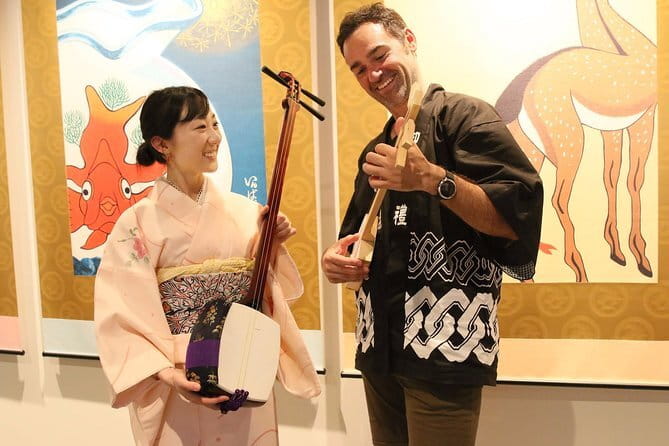
Before you assemble anything, the teacher explains the shamisen, including its basic history and features. The introduction is brief, which is the right choice for a two-hour session. You get enough context to understand what you are handling without losing time needed for making and playing.
The shamisen is a traditional Japanese string instrument, and this explanation helps you notice its shape, strings, and playing method. The workshop is designed for first-timers, so you do not need to arrive with music knowledge.
One useful feature is that the teaching appears to connect the explanation directly to the kit. Instead of treating background information as a separate lecture, the teacher shows you how the instrument is put together and how it produces sound. That approach makes the cultural information easier to remember.
More Live Music around Japan:
- Kyoto: Traditional Concert at Townhouse or Bathhouse
★ 4.9 · 224 reviews - Experience the Asakusa Kabuki Opera Show!
★ 5.0 · 99 reviews - Japanese Traditional Music Show in Tokyo
★ 5.0 · 72 reviews - Traditional Japanese Music show & Experience Tour in Kyoto
★ 5.0 · 57 reviews
Assembling the mini shamisen in about 20 minutes
The construction portion uses an introductory mini shamisen kit. The teacher first demonstrates the process, including how the parts fit together, and then you try it yourself.
The assembly takes about 20 minutes. That is short enough to keep the pace lively, yet long enough for you to feel that you made something rather than simply received a souvenir. The workshop notes that elementary school students have built the kits before, so the task is intended to be manageable for beginners.
You should still expect to pay attention. A handmade instrument is more satisfying when you take care with the pieces, strings, and fittings. If you are attending with a child, an adult may need to provide a little help, although the activity is clearly planned for a wide age range.
This is also where the price begins to make more sense. The instrument is not just an object handed to you at the end. You spend part of the session creating it, then use it immediately for the playing lesson.
Learning numbered music on the instrument you made
Once the mini shamisen is assembled, you begin making sounds and learning how to play. The music is designed for beginners, with simple scores and numbers on the mini shamisen showing where to place your fingers.
That numbered system is a major help. You do not need to read standard musical notation before arriving. You can look at the score, match the numbers on the instrument, and follow the teacher’s instructions.
I like this format because it gives you a quick sense of progress. A first lesson can become frustrating if the technique is too hard or the music moves too quickly. Here, the method is meant to get everyone playing together during the same visit.
The goal is not to become a shamisen musician in two hours. You are learning enough to understand the instrument, play a few songs, and enjoy the feeling of making traditional music with your own hands.
Playing together as a small group
After practicing, everyone plays together. The group limit of four people is especially useful at this stage. A large class can make it hard for the teacher to hear each person or correct basic mistakes. With only a few participants, you have a better chance to receive direct help.
Playing as a group also takes pressure off beginners. You are not expected to perform a solo in front of strangers. Instead, you follow the rhythm and simple score with the others. That makes the activity social without turning it into a high-stakes performance.
The small capacity may also suit solo visitors who prefer a quieter setting. If you are booking with family or friends, the four-person limit lets everyone take part without being spread across a large room.
The trade-off is availability. A small workshop has fewer spaces, and the experience is booked an average of 46 days in advance. If your schedule is fixed, reserve early rather than hoping to find an opening at the last minute.
Tea, sweets, and a live shamisen performance
The workshop includes a break with tea, sweets, and live shamisen music. This is more than a pause between activities. It gives you a chance to hear what the instrument can do when played by someone with real skill.
That contrast is useful. Your beginner playing may be simple and tentative, while the live performance lets you hear the shamisen in a more polished setting. You can listen to its tone, rhythm, and character without having to concentrate on finger placement.
Tea and sweets also slow the pace. The session is not a rushed sequence of instructions. You get a quiet moment to talk, watch, and absorb the setting.
For many people, this will be the most memorable section. The making activity gives you something to do, while the performance gives you something to appreciate. Together, they create a better picture of the instrument than either a lecture or a concert alone.
Taking your mini shamisen home
At the end, you take home the mini shamisen you assembled. You can also bring home the music practiced during the workshop.
This take-home element gives the activity lasting value. Many cultural activities end when you leave the venue. Here, you have a small instrument that can remind you of the session and let you show family and friends what you learned.
You should keep expectations realistic. A mini shamisen is an introductory instrument, not a replacement for a full professional shamisen. The workshop’s purpose is to give you an approachable first experience and a way to continue experimenting at home.
If you are buying the activity as a gift or planning a family outing, the take-home instrument is a strong advantage. It turns the workshop into both an activity and a souvenir.
Is $182.09 a fair price?
At $182.09 per person, this is a costly two-hour activity. The price will not suit every budget, especially if you are traveling with several family members.
The value depends on what you want. If you are looking only for entertainment during an afternoon, cheaper options are available. If you want a private-feeling cultural lesson, a handmade instrument, live music, tea, and a chance to practice, the price is easier to justify.
I would think of the cost as covering several parts:
- A guided cultural introduction
- A mini shamisen kit
- Assembly instruction
- Beginner music instruction
- A live performance
- Tea and sweets
- Sheet music to take home
- A small group setting
The instrument and personal instruction are the biggest value points. The group limit of four also matters, since you are not paying for a seat in a crowded class.
Group discounts are available, which may help if you are booking with others. Check the final price and discount terms before committing, since the advertised amount is per person.
Who will enjoy this most?
I would recommend this workshop to you if you want an activity that is creative, cultural, and easy to explain to children. Elementary school students and older can participate, and the simple numbered music means you do not need previous training.
It is also a good match for solo visitors who want personal contact with a teacher and a chance for international exchange. Couples and small families may appreciate the four-person maximum.
You may want to skip it if you are looking for a full-size instrument lesson, a long concert, or a low-cost attraction. The session is an introduction, not an advanced music course. Its strength is approachability.
The workshop also suits people who enjoy bringing home something they made. If you prefer sightseeing that leaves no physical souvenir, the instrument may not add much value for you. If you like practical keepsakes, it is one of the best reasons to consider booking.
Practical booking advice
Confirmation is provided at booking, and the experience is available with a mobile ticket. Most people can participate, and the activity is near public transportation.
Free cancellation is available when you cancel at least 24 hours before the start time. Cancellations made less than 24 hours before the session are not refunded, and late changes are not accepted. Cutoff times follow local time.
The activity requires good weather. If poor weather causes cancellation, you are offered another date or a full refund. Since the workshop is indoors, this condition may relate to transportation or access, so check the provider’s message if the forecast looks bad.
Should you book TOKYO SHAMI EXPERIENCE?
Book it if you want a personal introduction to Japanese music and like the idea of making your own souvenir. The strongest reasons are the four-person limit, beginner-friendly numbered music, live shamisen performance, and the chance to take the handmade instrument home.
I would reserve well ahead because openings may be limited, with bookings made an average of 46 days in advance. At $182.09, this is not a bargain activity, but it offers more than a demonstration. You spend time making, playing, listening, and learning in a small setting.
If those elements match your interests, TOKYO SHAMI EXPERIENCE is a thoughtful choice for an afternoon in Saitama. If you only want to hear traditional music, look for a concert instead. If you want to try the instrument yourself and leave with something you built, this workshop earns its higher price.
FAQ
Where does the shamisen workshop begin?
The workshop begins at Tokorozawa Station in Tokorozawa, Saitama, Japan.
What time does the workshop start?
The scheduled start time is 1:00 p.m.
How long does the experience last?
The workshop lasts approximately two hours.
How many people can join?
The activity has a maximum of four participants.
Is the workshop suitable for children?
Yes. Elementary school students and older can participate.
Do I take the mini shamisen home?
Yes. You take home the handmade mini shamisen you assembled, along with the sheet music practiced during the workshop.
What happens if bad weather cancels the experience?
If the activity is canceled because of poor weather, you are offered a different date or a full refund.
Just added around Japan
- Japanaese tradtional Tsugaru Shamisen music lesson in Tokyo★ 4.5 · 3 reviews
- Tsugaru shamisen performance over traditional dinner★ 5.0 · 9 reviews
- Traditional Japanese Music show & Experience Tour in Osaka★ 5.0 · 25 reviews
- Traditional Concert in Public bath near Kyoto Station★ 5.0 · 5 reviews
- Kyoto: Matcha & Traditional Japanese Music Immersive Experience★ 5.0 · 9 reviews
- Private Japanese music concert★ 5.0 · 4 reviews
- Kyoto: Kujo-yu Sento Traditional Japanese Instrument Concert★ 5.0 · 2 reviews
- Echoes of Peace – A Soul-Stirring Koto Concert in Hiroshima★ 4.5 · 5 reviews