
REVIEW · JAPAN
Traditional Japanese Music show & Experience Tour in Osaka
Music gets you close to a culture fast. This one-hour Osaka experience combines a live performance of hogaku, traditional Japanese music, with hands-on time playing instruments such as shamisen, koto, and wadaiko. I like the small maximum group of seven, and I like that the musicians welcome questions rather than keeping the instruments behind a barrier.
The $46.12 price feels fair for a compact cultural activity that includes both a concert and instrument practice. The main thing to watch is the limited schedule: sessions run only on Wednesday at 11:00 and Friday at 18:30. Also, the activity needs at least two participants to operate, so keep that condition in mind when planning your Osaka days.
Key points at a glance
- A real concert comes first: Spend about 25 minutes hearing professional musicians perform traditional Japanese music live.
- You get to handle the instruments: The second 25 minutes are set aside for trying instruments, including the shamisen, koto, and wadaiko.
- The group stays small: A maximum of seven participants makes it easier to ask questions and get a turn.
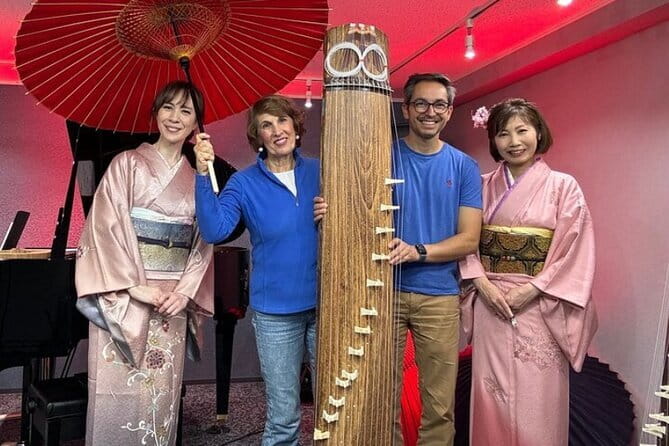
- The final 10 minutes are for photos: You can pose with the instruments and performers as a keepsake.
- Two weekly time slots: Choose Wednesday at 11:00 or Friday at 18:30.
- The meeting point is in Shinsaibashi: The activity begins and ends at Alpha Shinsaibashi, 3-chome-5-27 Minamisenba, Chuo Ward.
Why this short Osaka music experience works
Osaka offers plenty of food, shopping, and bright city streets. Those are all worthwhile, but a traditional music session gives you a quieter way to connect with Japan. You are not simply watching a performance from a distance. You hear the instruments, learn what they are, handle them, and try making sound yourself.
That change from listener to participant is the best feature here. A one-hour activity cannot teach you to master the shamisen or koto, of course. It can give you a clear first impression of how different these instruments feel and sound, which is far more memorable than reading a short museum label.
I also like the small-group setup. With no more than seven people, you should have a better chance to ask the musicians questions and receive attention during the practice section. The activity is not built as a large stage show where you sit quietly and leave. It has a personal, informal shape.
The tradeoff is that the schedule is narrow. If you are in Osaka for only a couple of days, Wednesday morning or Friday evening may not fit. The concert content also changes by day, so your exact program depends on when you attend. That adds variety, but it means you should not expect an identical show every time.
More Live Music around Japan:
- Kyoto: Traditional Concert at Townhouse or Bathhouse
★ 4.9 · 224 reviews - Experience the Asakusa Kabuki Opera Show!
★ 5.0 · 99 reviews - Japanese Traditional Music Show in Tokyo
★ 5.0 · 72 reviews
The 25-minute concert: hear the instruments in context
The first part lasts about 25 minutes and is a live Japanese music concert. Professional musicians perform a selection of traditional instruments, giving you a chance to hear their tone and rhythm before trying them yourself.
The listed instruments include the shamisen, koto, and wadaiko. Other instruments may appear as well, depending on the day. Since the content varies, you should think of each session as a particular program rather than a fixed set list.
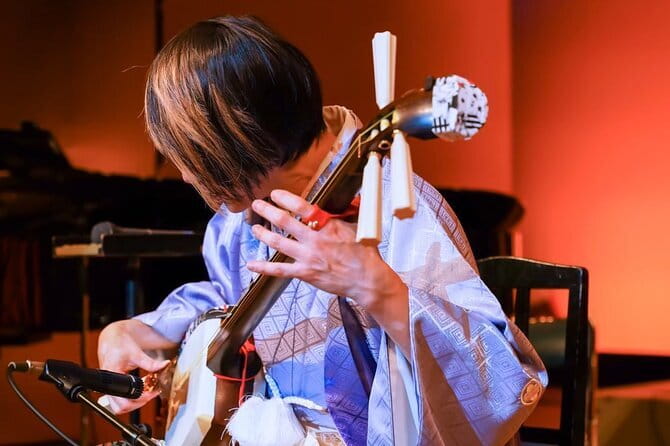
The shamisen is a Japanese lute with a distinct sound. It has a long neck and a compact body, and its tone can be bright, sharp, or expressive depending on how it is played. Hearing one live is useful because recordings do not always convey the physical character of the instrument.
The koto is often described as a Japanese harp, though its shape and playing method are different from a Western harp. It is a long string instrument with a graceful appearance and a clear, ringing voice. In a live room, you can listen for the contrast between the koto’s clean notes and the more percussive sounds of the wadaiko.
The wadaiko is a traditional Japanese drum. It brings force and rhythm to the program, and it helps show how broad Japanese music can be. The concert is not limited to one soft or delicate style. You may hear a range of sounds depending on the performers and the day’s content.
This first section matters because it gives you something to compare with later. After you listen to a professional performance, you will have a better sense of the skill involved when you pick up an instrument yourself. Your own first attempt may sound rather modest. That is part of the fun.
The 25-minute instrument session: from watching to playing
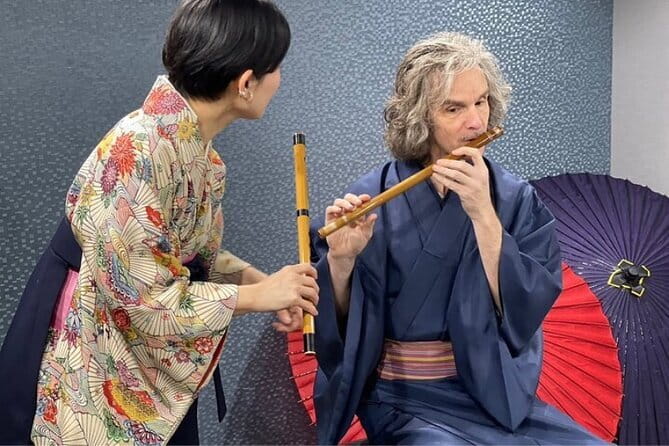
After the concert, about 25 minutes are devoted to trying traditional Japanese musical instruments. The activity includes a Japanese instrument for the experience, and the listed examples are shamisen, koto, and wadaiko.
This is where the tour earns much of its value. Many cultural performances stop after the applause. Here, you get a direct physical connection with the instruments. You can discover that an object that looks simple may require careful hand placement, controlled movement, and a good sense of timing.
I would treat this section as an introduction rather than a lesson aimed at producing a polished performance. The goal is to try, listen, and ask questions. You may find that one instrument appeals to you more than the others. You may also gain a fresh respect for the musicians after discovering how difficult it is to create an intentional sound.
The experience is suitable for people with no musical background. The information provided says most people can participate, and no special skill level is listed. Families, couples, solo visitors, and music fans can all get something from the session. It may be especially useful if you want an activity that feels more active than a standard concert but less demanding than a full class.
Because the group is capped at seven, the practice should have a more personal feel than a large workshop. You can ask the musicians as many questions as you like. That open question time is valuable because the instruments have details that are hard to understand from a short performance alone.
Ask about how the instrument is held, what creates its sound, or how the musicians use rhythm. The experience description specifically encourages questions, so do not feel that you must remain silent once the concert ends.
The final 10 minutes: photos with the performers and instruments
The last 10 minutes are set aside for photographs. You can take pictures holding traditional instruments and posing with the performers.
This may sound like a small addition, but it gives the hour a pleasant finish. If you are collecting memories of Osaka, a photograph with a shamisen, koto, or wadaiko offers something different from the usual city view or food picture. It also helps you remember which instruments you tried.
The time is limited, so plan to make the most of it. If you are attending with friends or family, decide in advance whether you want group photos, individual pictures, or both. The activity does not promise a long photo session, and the 10-minute slot needs to accommodate everyone.
I also see this section as a chance to ask any final questions. If you are curious about the performers, the instruments, or the music you heard, the end of the session gives you a natural moment to speak with them.
Same city, a different sound:
- Traditional Japanese Music show & Experience Tour in Kyoto
★ 5.0 · 57 reviews - Concerts Played with Traditional Instruments in Kyoto
★ 5.0 · 50 reviews - Kyoto: Japanese Koto & Shamisen Concert and Koto Class
★ 4.9 · 31 reviews - Tokyo: Traditional Asakusa Music Show with Dinner
★ 5.0 · 10 reviews
A closer look at the meeting point in Shinsaibashi
The activity starts at Alpha Shinsaibashi, located at 3-chome-5-27 Minamisenba in Osaka’s Chuo Ward. It ends back at the same meeting point, so you do not need to arrange transport from a separate finish location.
The location is near public transportation, which makes it practical to fit into an Osaka sightseeing day. Still, leave enough time to locate the building and arrive ready for the scheduled start. The Wednesday session begins at 11:00, while the Friday session begins at 18:30.
The two time slots serve different travel plans. Wednesday morning can work well before lunch and afternoon sightseeing. Friday evening may suit you after a day in the city, though you should consider how the session fits with dinner plans.
Private transportation is not included. That is not a serious drawback in central Osaka, but you are responsible for getting to the meeting point. The activity begins and ends there, which keeps the transport arrangements simple once you arrive.
Timing, group size, and what they mean for you
One hour is a useful length for this kind of cultural stop. You get a proper performance, a hands-on period, and photographs without giving up half a day. If your Osaka schedule is tight, this is easier to fit between other activities than a longer workshop.
The small maximum group of seven is another strong point. A large class can turn instrument practice into a queue. With a smaller group, you have a better chance to ask questions and receive a turn without feeling lost in the crowd.
The minimum of two participants creates one practical uncertainty. The activity needs at least two people to operate. If that minimum is not met and the session is canceled, you can receive a full refund or be offered a different date or experience.
The changing concert content is worth noting too. It means a Wednesday visit may not be identical to a Friday visit. If you attend more than once, you could hear a different program, but you should not book expecting the exact same performance each time.
Is $46.12 good value?
At $46.12 per person, this is not the cheapest hour you can spend in Osaka. It is also more than the cost of simply hearing free music in a public place. The comparison is not quite fair, though, because this price covers a professional live performance, instrument handling, questions, and photographs in a group capped at seven.
The strongest value comes from the hands-on portion. A short concert alone might feel expensive at this price. The chance to play the instruments yourself changes the calculation and makes the activity more than a passive show.
I would recommend it most to people who value direct cultural contact. If you love music, enjoy workshops, or want an activity that gives you a story to take home, the price is reasonable. If you only want a polished stage performance, you may prefer to spend the money elsewhere.
The activity includes a Japanese musical instrument for the experience. Private transport is not included, so add your local transport costs when planning your budget. No food or other extras are listed, so do not expect this to replace a meal or a full cultural class.
Who should book this experience?
This is a good match for a first visit to Osaka when you want something beyond the major sights. You do not need to be a musician. The session is designed around listening, trying, asking questions, and enjoying the process.
I would especially suggest it for:
- Music lovers who want to hear traditional instruments up close
- Couples looking for a short cultural activity
- Families seeking something hands-on
- Solo visitors who enjoy asking questions and learning directly from performers
- Visitors with a free Wednesday morning or Friday evening
- Anyone who wants a photo and memory that feels distinctly Japanese
The activity may be less suitable if you need a fully flexible schedule. There are only two listed sessions each week, and the minimum participant rule means the activity is not guaranteed to run if too few people book.
It is also not the right choice if you want a long, advanced music lesson. The experience lasts one hour, with only 25 minutes for instrument practice. You will get an introduction, not professional training.
Practical booking advice for Osaka
Confirmation is provided when you book, and the ticket is mobile, so you can keep it on your phone. The activity is near public transportation and most people can participate. Service animals are allowed.
The cancellation terms are friendly if your plans may change. You can cancel at least 24 hours before the local start time for a full refund. Cancellations or changes made within 24 hours are not accepted, and the amount paid is not refunded.
Because the start times are fixed, check your Osaka plans before booking. For the Wednesday 11:00 session, allow time to reach Shinsaibashi without rushing. For Friday at 18:30, leave room for the activity to finish before your evening plans.
The booking pattern suggests that many people reserve about a month ahead, with an average of 31 days. That does not guarantee that every date sells out, but it is a useful sign for anyone visiting during a busy season. If this is important to your itinerary, booking early is sensible.
What makes the experience memorable
The most praised feature is the chance to hear beautiful instruments close up and then play them. That two-part design is the reason I would choose this over a concert with no audience participation.
The activity also works well because it keeps the focus on real objects and real sounds. You are not just receiving a broad explanation of Japanese culture. You are learning through your ears, hands, and questions.
The final photos add a simple personal touch. You can leave with a record of the experience, but the larger reward is the new understanding of how the instruments feel and function. Even a brief attempt can change the way you listen to Japanese music later.
Should you book this Osaka music tour?
Book it if you have a free Wednesday morning or Friday evening and want a small, friendly introduction to Japanese music. The live concert, hands-on instrument time, open questions, and photo session make the $46.12 cost reasonable for a one-hour cultural activity.
Skip it if your schedule cannot handle the fixed times, if you want a longer music course, or if you prefer a large theatrical performance. For everyone else, this is a practical and enjoyable way to hear the shamisen, koto, and wadaiko, then discover what they feel like in your own hands.
FAQ
How long does the traditional Japanese music experience last?
The total duration is approximately one hour. It includes about 25 minutes of concert music, 25 minutes of trying instruments, and 10 minutes for photographs.
Where does the activity begin?
It begins at Alpha Shinsaibashi, 3-chome-5-27 Minamisenba, Chuo Ward, Osaka, 542-0081, Japan.
Where does the activity finish?
The activity ends back at the meeting point.
What instruments might I experience?
The listed instruments include the shamisen, koto, and wadaiko, along with other traditional Japanese instruments.
When is the experience available?
Sessions are listed for Wednesday at 11:00 and Friday at 18:30.
Can I ask the musicians questions?
Yes. You can ask the professional musicians as many questions as you like.
Can I take photographs?
Yes. The final 10 minutes are reserved for photographs with the instruments and performers.
How many people can join the activity?
The maximum group size is seven participants. At least two participants are required for the activity to operate.
Can I cancel for a full refund?
Yes. You can cancel at least 24 hours before the local start time for a full refund. Cancellations or changes made less than 24 hours before the start time are not accepted and are not refunded.
Just added around Japan
- Japanaese tradtional Tsugaru Shamisen music lesson in Tokyo★ 4.5 · 3 reviews
- Tsugaru shamisen performance over traditional dinner★ 5.0 · 9 reviews
- Easy for everyone! Now you can play handmade mini shamisen and show off to everyone! Musical instruments, sweets and live music★ 5.0 · 3 reviews
- Traditional Concert in Public bath near Kyoto Station★ 5.0 · 5 reviews
- Kyoto: Matcha & Traditional Japanese Music Immersive Experience★ 5.0 · 9 reviews
- Private Japanese music concert★ 5.0 · 4 reviews
- Kyoto: Kujo-yu Sento Traditional Japanese Instrument Concert★ 5.0 · 2 reviews
- Echoes of Peace – A Soul-Stirring Koto Concert in Hiroshima★ 4.5 · 5 reviews
Tours, compared.

Liverpool: City & Beatles Tour with Live Guide & Live Music
Read our review →Sydney Opera House Official Guided Walking Tour
Read our review →

Alfama Tour and Live Fado with Traditional Dinner
Read our review →
Schönbrunn Palace Evening Tour, Dinner and Concert
Read our review →Browse the lists this tour appears in