
REVIEW · CHINA
Jinjiang Theater:Eight-Face Changing-Legendary Sichuan Opera
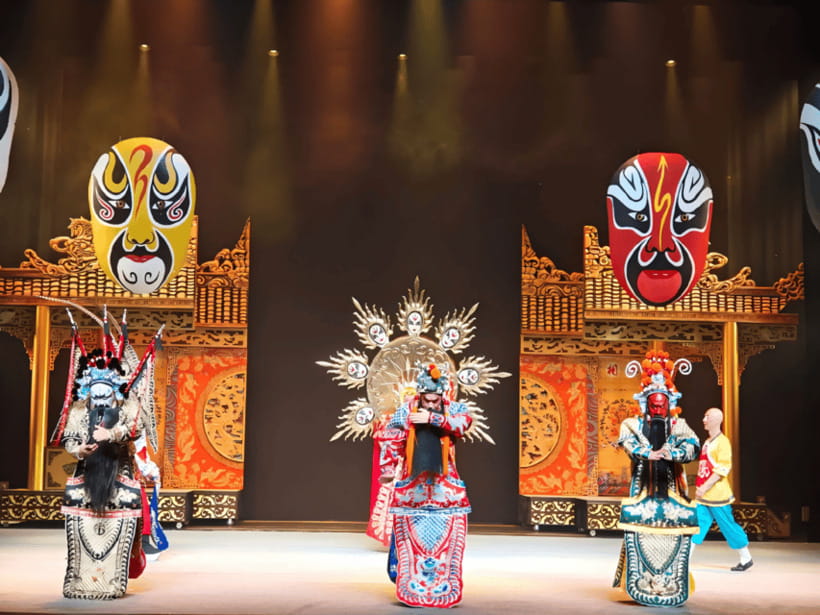
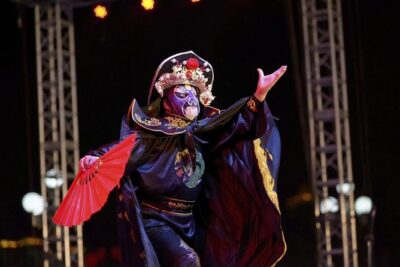
Faces change in a blink. At Chengdu’s Jinjiang Theater, Sichuan opera packs face-changing, fire breathing, puppetry, acrobatics, dance, and traditional tea into a lively 70-minute show. I especially like the eight-face changing finale, a rare specialty built around a clear story, and the included Gaiwan tea served beside the theater before the performance. The main caution is that this is a fast-moving stage production, not a quiet, fully translated introduction to opera.
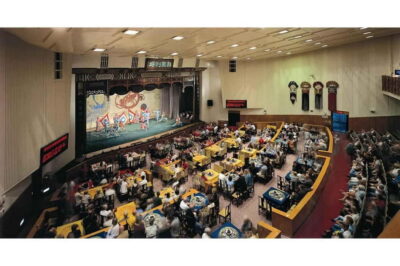
The theater sits near Tianfu Square, so it is easy to pair with central Chengdu sightseeing. Seats are assigned within your ticket area, and you must have the emailed ticket serial number, QR code, and seat number to enter. Lose that email, and your evening can become much less entertaining than the show.
Key things to know before you go
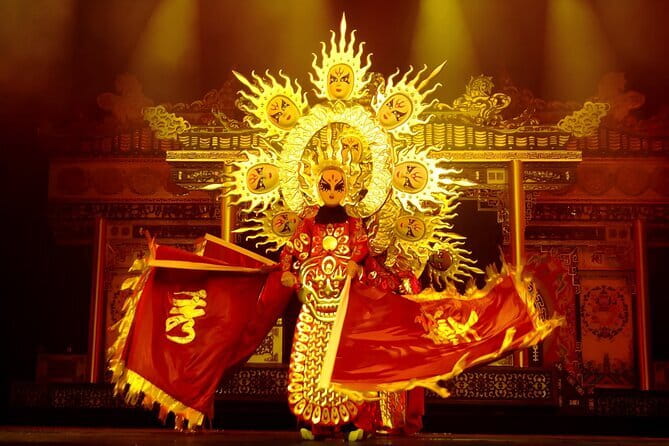
- Eight-face changing: The signature act builds toward eight painted faces changing during one continuous performance.
- A story behind the spectacle: Little Sanqing learns the art after hardship, hiding, practice, and a forced mask.
- Tea before the curtain: Your ticket includes one bowl of covered-bowl tea at Yuelai Tea House, next to the theater, one hour before showtime.
- More than face-changing: Expect opera excerpts, hand shadows, fire breathing, umbrella kicking, puppetry, costume changes, and dance.
- Central location: Jinjiang Theater is at No. 54 Huaxing Street, near Tianfu Square in Chengdu.
- Good family value: One adult ticket includes one child under 1.2 meters free, provided the child does not use a seat.
What the Jinjiang Theater show is really offering
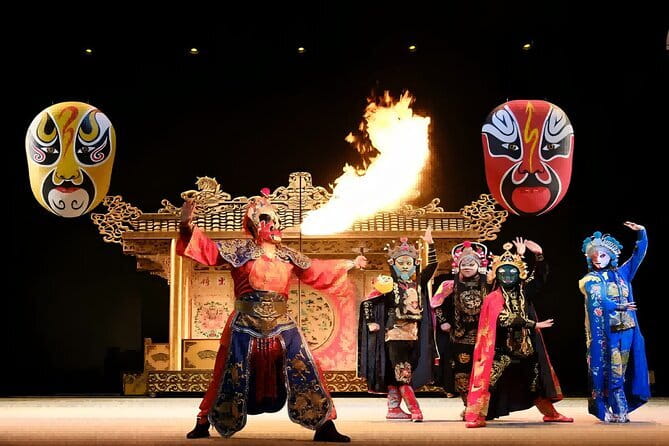
Sichuan opera is not just a parade of painted masks. Its traditional craft combines singing, spoken delivery, stylized movement, martial arts, character gestures, and special stage skills. This production keeps those elements at its core, then adds modern theatrical variety to hold the attention of a broad audience.
That balance matters. If you already know Sichuan opera, you will see familiar forms presented beside newer acrobatics and stage effects. If this is your first introduction, you get a quick tour of the art without needing to commit to a long evening of opera.
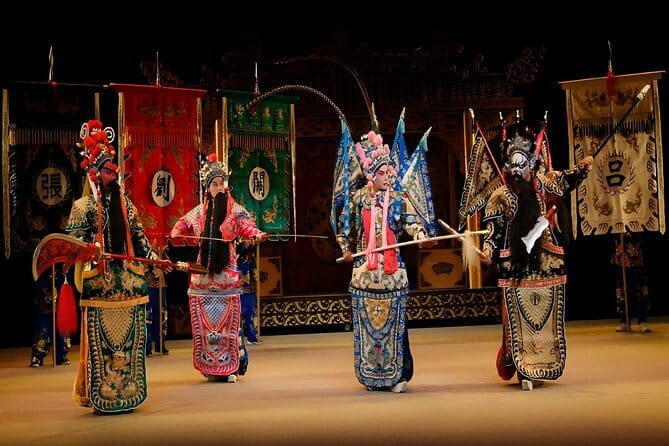
The program includes excerpts such as The Three Heroes Fight Lü Bu and Releasing Pei. It also features the lamp play Rolling Lantern, where performers display the distinctive qualities of young male and young female roles. These segments help show that opera depends on precise movement and character types, not only painted faces.
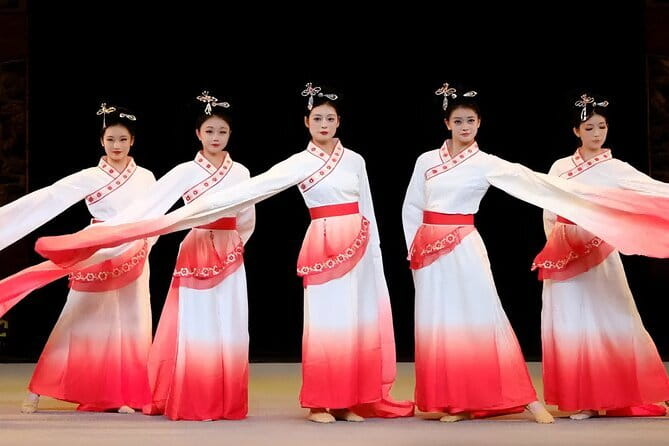
The production also brings in hand-shadow art, a puppet performance called The Beauty of Life, and a traditional fashion show. Water sleeve dance and ghost immortal dance add long, flowing gestures and a more dreamlike mood. The result is closer to a staged cultural showcase with a story running through it than to one uninterrupted opera scene.
That format is useful for you if you want variety. It also explains the one drawback: the show moves quickly from one attraction to the next. You may not get a detailed explanation of every custom or opera convention before the next act begins.
More Chinese Opera Shows around Chengdu:
- Chengdu: Sichuan Opera Shu Feng Yan Yun Evening Show Ticket
★ 4.7 · 185 reviews - Chengdu Sichuan Opera Show Ticket – Shu Feng Ya Yun
★ 4.4 · 73 reviews - Chengdu: Sichuan Opera Show Ticket – Shu Feng Ya Yun
★ 4.8 · 30 reviews
The story of Little Sanqing and Little Huanhua
The main narrative takes place at Sanqinghui in Chengdu, the historic site associated with the present Jinjiang Theater. The setting connects the stage to one of Sichuan opera’s important birthplaces and gives the performance a local anchor.
Little Sanqing is a serious opera student. He practices hard, and his master eventually agrees to accept him as a disciple. Little Huanhua, a young woman linked to his life, falls in love with him. Their relationship gives the story a human center before the stage skills take over.
The conflict arrives through Young Master Ma, who takes Little Huanhua by force. His men burn Little Sanqing’s face, leaving him disfigured and unable to live openly as before. He hides behind a mask and continues practicing in secret.
This hardship explains the changing faces. The skill is not presented as a random trick but as something Little Sanqing develops through pain, patience, and determination. He eventually perfects eight-face changing in one uninterrupted performance and becomes a master of the craft.
Little Huanhua later finds him, and the two return to the opera stage together. The story is simple, but it gives the spectacle a reason to exist. You are not only waiting for the next surprise. You are following a performer who turns a personal wound into an artistic achievement.
The performance program, act by act
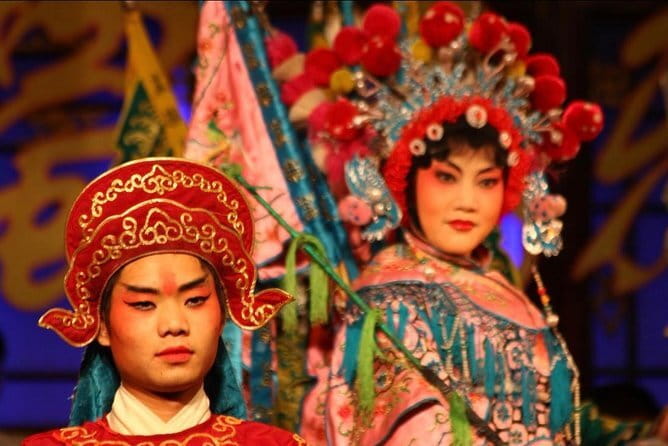
The exact running order can vary in presentation, but the listed program gives you a good picture of the evening.
The Three Heroes Fight Lü Bu
This opera excerpt introduces the martial side of Sichuan opera. Expect stylized combat and theatrical movement rather than realistic fighting. It is a useful opening because it shows how the stage can suggest action through rhythm, gesture, costume, and controlled choreography.
More Live Music around Chengdu:
- Sichuan Culture Opera Show in Chengdu
★ 4.5 · 69 reviews - Chengdu Sichuan Opera Evening Show Ticket-Shu Feng Yan Yun
★ 5.0 · 15 reviews - Chengdu: Sichuan Opera Show ShufengYayun & Covered Bowl Tea
★ 4.2 · 14 reviews - Shu Feng Ya Yun Sichuan Opera Ticket
★ 5.0 · 13 reviews
Hand shadow art
Hand shadows bring a smaller, more delicate form of theater into the program. This kind of act can be especially appealing if you are attending with children, since the image-making is easy to understand even without Chinese language skills.
Umbrella kicking
The umbrella-kicking acrobatic act shifts the mood toward circus-style skill. It offers a clear visual challenge: balance, timing, and control are all visible from the audience. It also breaks up the singing and movement of the opera excerpts.
Hidden knife
The hidden knife is listed as a Sichuan opera specialty. Like face-changing and fire breathing, it belongs to the tradition of revealing a sudden surprise through precise stage technique. You should not expect a detailed explanation of how it works. The pleasure is in watching the reveal.
Releasing Pei
This second opera excerpt returns to the dramatic and musical side of the art. It helps keep the show from becoming a string of unrelated tricks. The opera scenes provide the traditional framework around which the specialty acts are arranged.
Fire breathing
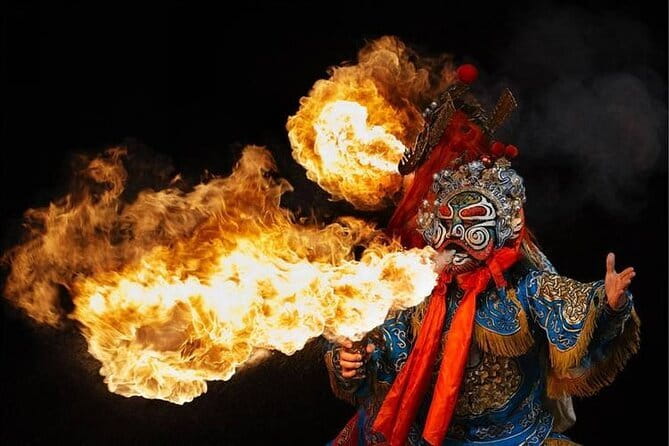
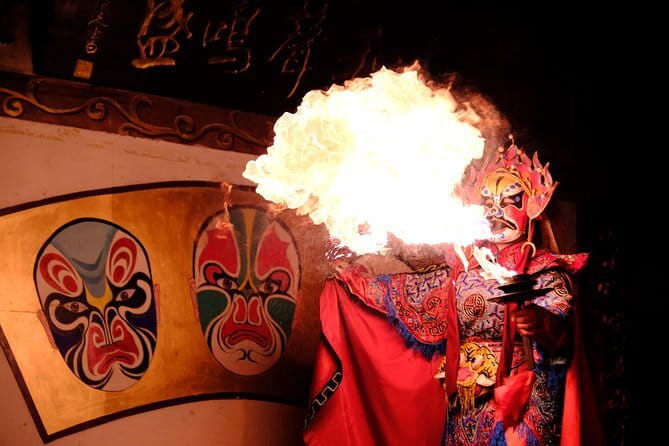
Fire breathing is one of the most immediately understandable moments in the program. It needs no translation, and the burst of danger adds a strong change of pace. This is also one reason the show works well for a mixed-age group with different interests.
Rolling Lantern
The rolling lantern performance highlights the Xiao Sheng and Xiao Dan roles, or young male and young female characters. It is a chance to see the stylized character work that can get lost when people focus only on the famous face-changing act.
Multi-person drum kicking
This acrobatic number adds teamwork to the program. Several performers coordinate with a drum, making the act less about one individual’s feat and more about shared timing.
The Beauty of Life
The puppet show offers another traditional art form within the larger production. It gives you a change in scale and movement, especially after martial arts and acrobatics.
Face-changing and eight-face changing
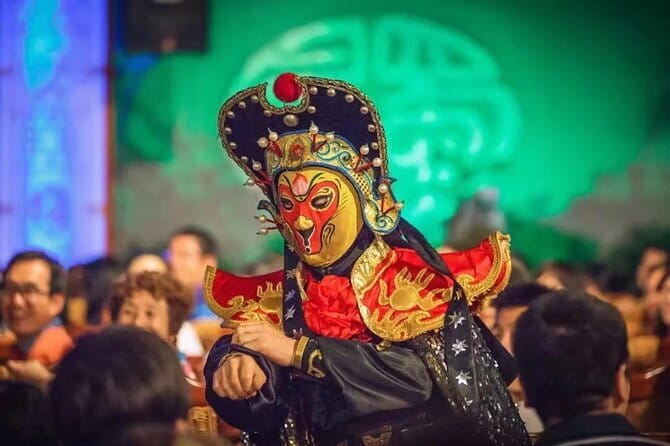
This is the centerpiece. Ordinary face-changing is already a famous Sichuan opera skill, but the advertised eight-face changing act is the special feature here. The masks or painted faces change with remarkable speed while the performer keeps the method hidden.
The best way to watch is to stop trying to catch the secret. Look at the performer’s posture, turns, music cues, and timing. The mystery works because the whole body participates in the act, not just the face.
Three costume changes
Costume changes extend the same idea of transformation beyond the face. Clothes, color, shape, and movement all affect how a character reads on stage. This section also gives you a chance to notice the visual design between the bigger special effects.
Traditional fashion show and dance
The fashion show, water sleeve dance, and ghost immortal dance move the finale toward color, flowing fabric, and group movement. A fan dance is also included in the broader production, adding a clean, coordinated pattern to the stage picture.
The mix can feel busy, but that is part of the point. The production wants to show how opera connects with acrobatics, dance, puppetry, magic, and visual design.
Why the included Gaiwan tea matters
Your ticket includes a bowl of traditional covered-bowl tea at Yuelai Tea House, directly beside the theater. You can collect it one hour before the performance by showing your ticket serial number or QR code.
This is a small inclusion, but it improves the evening. Gaiwan tea is served in a lidded bowl, and the lid helps hold back tea leaves while you drink. It gives you a brief taste of Sichuan’s tea culture before the stage lights come on.
Do not treat the tea as a separate tasting tour. It is one complimentary serving, not a long tea ceremony or a guided lesson. Still, it is a sensible use of the hour before the show, especially if you are already in central Chengdu and do not want to find another place to wait.
You cannot bring food into the theater, so enjoy the tea outside before you take your seat. Alcohol and drugs are not allowed, and the performance prohibits video recording.
Location, timing, and ticket details
Jinjiang Theater is at No. 54 Huaxing Street in Jinjiang District, Chengdu, near Tianfu Square. The activity lasts about 70 minutes and ends back at the theater.
The ticket price is about $20 per person. I consider that fair value if you want a compact introduction to Sichuan opera with several different art forms included. A standard stage ticket at this price would already be reasonable for a central Chengdu evening. Here you also receive the tea and a program that includes special acts, dance, puppetry, and acrobatics.
The value is strongest for first-time visitors, families, and anyone with only one free evening in Chengdu. If your main goal is a long, scholarly presentation of opera, this may feel too short and too show-oriented.
Your seat is selected within the designated ticket category, but seats are randomly assigned. You cannot assume you will choose a particular row or exact position. If seating is important to you, check the ticket category carefully and arrive with the assigned seat information ready.
The most important practical rule is simple: check your email. You need the ticket serial number, QR code, and seat number to enter. The same message should contain instructions about the address, contact information, and ticket collection process. If it has not arrived, contact SUKHA Travel before you go rather than waiting at the theater.
The host or greeter information lists Chinese and English. That can help with basic arrival and ticket questions, but the performance itself is a Chinese cultural production, not an English-language theater show.
Who will enjoy this most
I would choose this experience for you if you want to see several traditional Chinese performance arts in one sitting. It is especially suitable for a first night in Chengdu, when you want a cultural activity that does not require a full evening of language study.
Families should find the visual variety helpful. Fire breathing, puppets, hand shadows, drum kicking, costume changes, and face-changing offer plenty to watch. One adult ticket covers one child under 1.2 meters at no extra charge, and that child does not occupy a seat. Children over 1.2 meters need a full-price ticket.
The show also suits people who enjoy theatrical skill more than spoken explanation. Much of the appeal is visual, so you can follow the action even if you do not speak Chinese.
I would hesitate if you dislike loud stage effects, rapid changes, or mixed-format entertainment. The performance does not stay with one plot or one style for long. It is designed to keep the stage moving.
A few practical ways to improve the evening
Arrive with your digital ticket open and ready. Do not rely on remembering the booking name alone. The serial number, QR code, and seat number are the items you need.
Use the hour before the show for the included tea at Yuelai Tea House. Since it is right next to the theater, you do not need to build a separate trip around it. Present the serial number or QR code to receive the tea.
Plan food before entering. Food is not allowed in the theater, and the 70-minute show is short enough that you can eat either before the tea or after the performance.
Keep your phone for directions and ticket access, but do not record once the performance begins. The no-recording rule protects the artists and keeps screens from distracting people around you.
The activity allows free cancellation up to 24 hours in advance, and you can reserve now and pay later. Those options help if your Chengdu schedule is still shifting, though you should still check the final booking terms when you select your date.
Should you book the Jinjiang Theater show?
I would book it if you want an affordable, central, easy-to-follow introduction to Sichuan opera. The eight-face changing act is the clear reason to go, but the full program gives you more value than a single specialty performance. Fire breathing, puppetry, shadow art, acrobatics, dance, costume changes, opera excerpts, and tea make the evening feel varied.
I would skip it only if you want a slow, traditional opera performance with extensive explanation. For everyone else, the $20 price, 70-minute length, Tianfu Square location, and family-friendly format make this a practical Chengdu choice. Just save the ticket email, arrive prepared, and let the performer keep the secret.
FAQ
Where is Jinjiang Theater located?
Jinjiang Theater is at No. 54 Huaxing Street, Luoma City, Jinjiang District, Chengdu, Sichuan Province, near Tianfu Square.
How long does the performance last?
The performance lasts about 70 minutes. Starting times depend on the date and availability.
What does the ticket include?
The ticket includes entry with a selected seat and one complimentary bowl of covered-bowl tea at Yuelai Tea House, next to the theater, one hour before the performance.
What do I need to enter the theater?
You need the ticket serial number, QR code, and seat number sent by email. Without these details, you cannot enter.
Are seats assigned?
Yes. Seats are randomly assigned within the designated ticket area.
Can children attend for free?
One adult ticket includes one child under 1.2 meters free of charge, provided the child does not occupy a seat. Children over 1.2 meters require a full-price ticket.
Can I record the show or bring food inside?
No. Video recording is not allowed, and food is not permitted inside the theater. Alcohol and drugs are also prohibited.
Just added around Chengdu
- Sichuan Opera Show with Hotel Pickup★ 5.0 · 3 reviews
- Skip the Line: Sichuan Opera Chengdu Ticket★ 4.0 · 8 reviews
- Classsic sichuan Opera at sichuan Provincial Theater★ 5.0 · 4 reviews
- Chengdu Signature Opera Face Changing and Tea★ 5.0 · 7 reviews
- Shu Feng Ya Yun Sichuan Opera Ticket★ 5.0 · 13 reviews
- Sichuan Opera with face-changing at Sichuan opera theater★ 4.5 · 6 reviews
- Chengdu Sichuan Opera Evening Show Ticket-Shu Feng Yan Yun★ 5.0 · 15 reviews
- Jinjiang Theater: Eight-Face Changing-Legendary Sichuan Opera★ 5.0 · 6 reviews
Chinese Opera Shows, compared.
Sichuan Opera Shu Feng Yan Yun Evening Show Ticket
Read our review →
Chengdu Sichuan Opera Show Ticket – Shu Feng Ya Yun
Read our review →
Beijing LiYuan Theatre VIP Seats Opera Show with Private Transfer Service
Read our review →
Chengdu Sichuan Opera Evening Show Ticket-Shu Feng Yan Yun
Read our review →Browse the lists this tour appears in